 The Edinburgh Tour Guide
Greyfriars Bobby is a small bronze dog on a street corner, and it is one of the most photographed objects in Edinburgh. It is also a drinking fountain, a Category A listed building, and visibly damaged in a way that nobody warns you about before you join in.
Look at it, photograph it, do not rub it. The bright gold nose is not a design feature: it is bronze worn back by hands. The council spent around £400 restoring it and the repair failed within a year. Also worth knowing before you go: the statue is a fountain, the grave is a separate thing inside the kirkyard, and the famous story has been disputed since 1889.
Cost
Nothing
Listed
Category A, 1977
The nose
Leave it alone
The nose, which is the thing nobody tells you
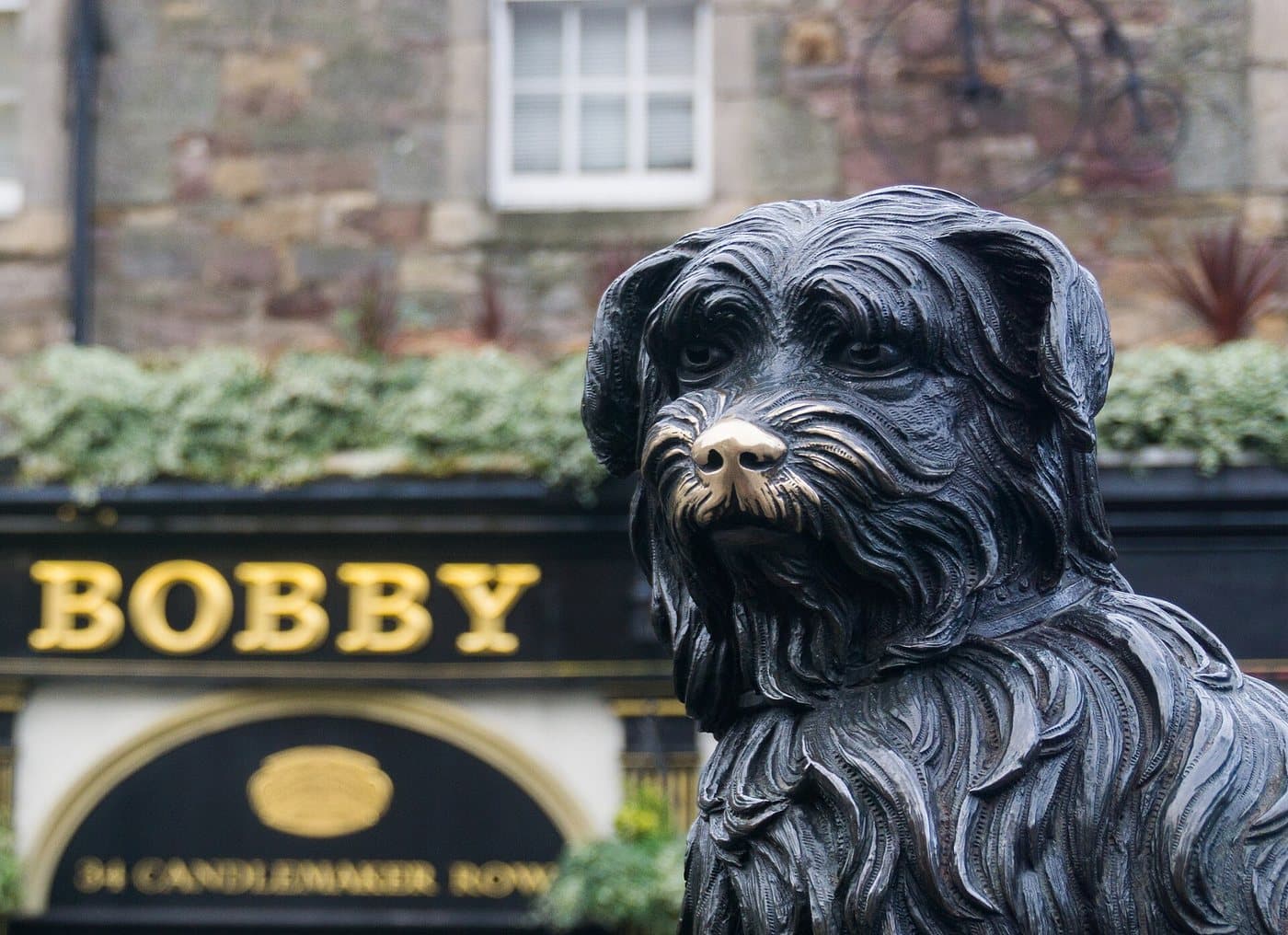
Rubbing the nose for luck is the single most common thing visitors do here, and the result is in the photograph above: a bright gold snout on an otherwise black bronze dog. That is not polish. It is the protective patina worn off the metal underneath.
Here is what makes this worth a section rather than a sentence. The blogs and the Tripadvisor reviews shout at you never to touch it. The City of Edinburgh Council, when it actually addressed this, said something more measured, and quoting it properly matters more than joining a pile-on. Speaking to the BBC on 31 October 2014, Richard Lewis, then the council's culture and sport convener, said:
What the council actually said, in 2014
The council arranged for work to be carried out to fix Bobby's nose 12 months ago, but damage is still being done and the restoration is already wearing off.
In time, we will organise repair work again to maintain the statue, which we know is one of Edinburgh's most loved monuments, but there are no plans to carry out more work in the near future.
If people do feel obliged to rub Bobby's nose could we encourage them to do it gently, as it really does cause damage.
The restoration had cost around £400 and had lasted about a year. Two things follow. First, that quote is eleven years old, so treat it as the council's position then rather than its policy now: we have not found a newer statement and we are not going to invent one. Second, and more usefully, the wear you can see in the photograph is the accumulated result of everyone deciding their own individual rub would not matter.
Our own advice is shorter than the council's: don't. It is a Category A listed monument to a dog, it costs nothing to look at, and the luck is imaginary.
Is it worth your time
Yes, for about four minutes. It is a small statue on a pavement, it is free, and it sits at a junction you will cross anyway: the southern end of George IV Bridge, directly opposite the National Museum of Scotland and a few steps from the gate of Greyfriars Kirkyard. Do not make a trip for it. Do build it into the walk between the museum and the Grassmarket, which passes it.
Nothing sells a statue on a street corner, so there is nothing for us to book you here. One walking tour does genuinely include it, by its own itinerary rather than by our stretching, and we earn a commission if you use it.

Old Town Highlights Walking Tour (Sandemans)
Covers the Royal Mile, Greyfriars Kirkyard and the Grassmarket, and its own description names Bobby. Run on the tip model, so the £3.49 is a booking fee and what the guide earns is what you hand over at the end.
It is a fountain, and the smallest listed building in Edinburgh
Stand in front of it and you are looking at a monument that the state protects at the highest grade available in Scotland. The listing record, which is the primary source for all of this, describes it plainly:
| What | The record says |
|---|---|
| Listing | Category A, reference LB27899, added 29 April 1977 |
| Official name | George IV Bridge, Greyfriars Bobby Fountain |
| Maker | William Brodie, 1873 |
| What it physically is | Life-size bronze terrier on a cylindrical red granite plinth, with an octagonal basin at the base and a higher circular basin |
| Commissioned by | Baroness Burdett-Coutts, of the Ladies Committee of the RSPCA |
Two basins, because it was a drinking fountain: the higher one for people, the low one at ground level for dogs. It has not run in a long time, and the vast majority of people photographing the terrier never register that they are standing at a piece of Victorian street plumbing.
Wikipedia calls it Edinburgh's smallest listed building, which we are happy to pass on as their claim. The inscription on the base is worth reading before you leave, because it is the original 1870s framing of the whole story:
The inscription, as recorded in the listing
A tribute to the affectionate fidelity of Greyfriars Bobby. In 1858 this faithful dog followed the remains of his master to Greyfriars churchyard and lingered near the spot until his death in 1872. With permission erected by Baroness Burdett Coutts.
There are three Bobby memorials, and you are looking at the wrong one
This is the most useful practical thing on this page. Historic Environment Scotland records three separate objects of pilgrimage, and the one everybody photographs is the one on the street:
| Which | Where | Put there by |
|---|---|---|
| The fountain and statue | Outside, on the pavement | Baroness Burdett-Coutts, 1873 |
| A stone over John Grey's grave | Inside the kirkyard | American dog lovers |
| A memorial to Bobby | Inside, near the kirkyard entrance | The Dog Aid Society of Scotland, 1981 |
So the grave of the master the whole story is about is behind a gate that most people walk straight past, and it was marked not by the city but by visitors from another country. The kirkyard is free to enter and open in daylight.
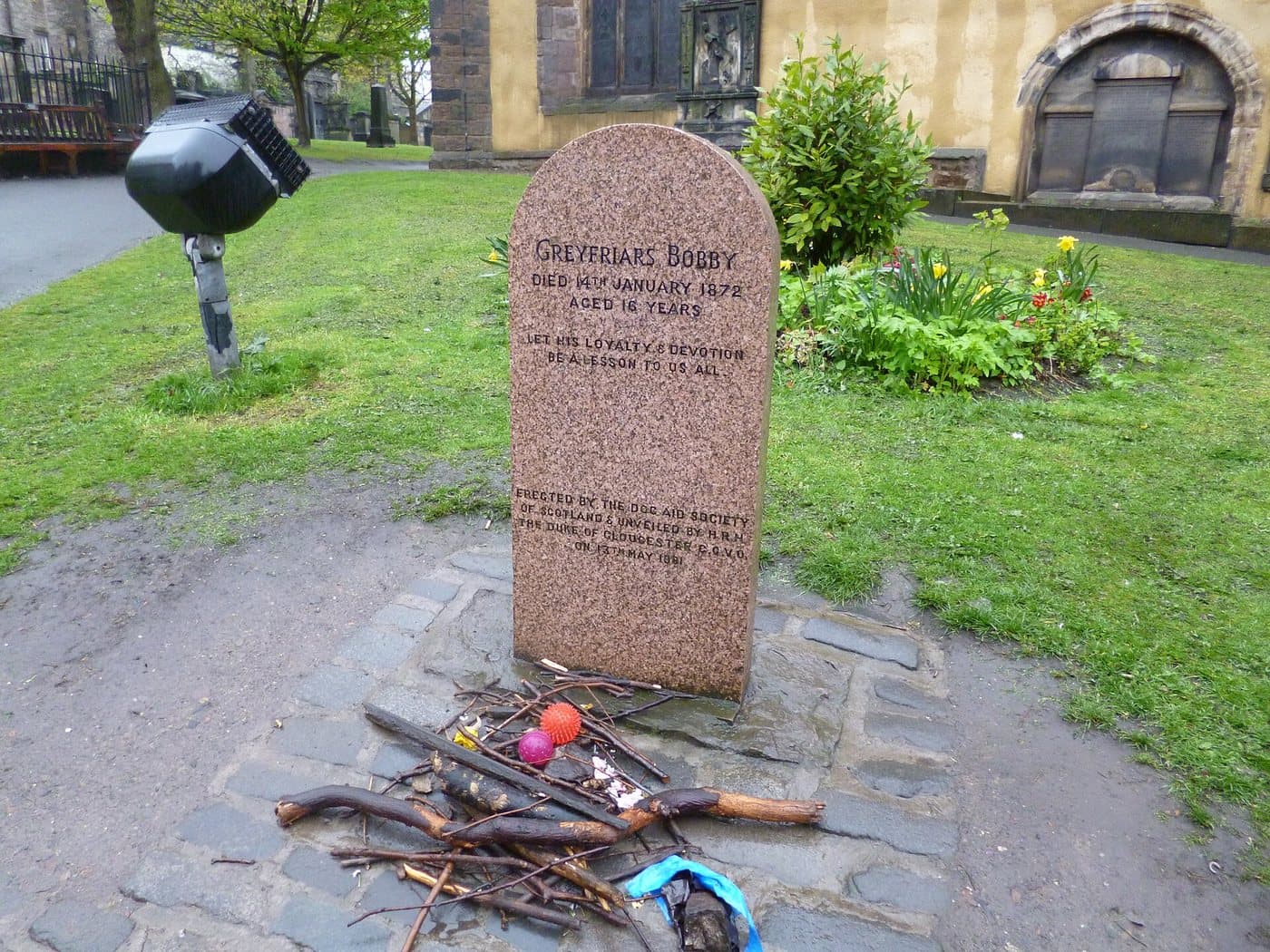
The 1981 stone in the photograph above carries its own details, legible if you go and look: Greyfriars Bobby, died 14th January 1872, aged 16 years. Let his loyalty and devotion be a lesson to us all
, and below that a note that it was erected by the Dog Aid Society of Scotland and unveiled by the Duke of Gloucester on 13 May 1981. The listing record mentions the stone but not the sticks piled at the foot of it, which are left by visitors and are the single most affecting thing at either site. Note the boundary with our other pages: the Covenanters' Prison at the far end of the same graveyard is a different subject with different access rules, and we deal with it on the ghost tours page, while the gravestone names that turn up in a certain series of novels are on the Harry Potter page.
Whether any of it is true, and why that is an old question
The story as the inscription tells it is that Bobby followed John Grey's body into the churchyard in 1858 and stayed near the grave until his own death in 1872. Historic Environment Scotland notes, drily, that the story became a cult soon after the dog's death
.
It has also been argued about almost from the start. This is not a modern debunking. Wikipedia's account records that two letters were printed in The Scotsman on 8 February 1889, both from people claiming close links to Greyfriars Kirk and to have known the dog personally, and they took opposite views on whether the story was accurate. Seventeen years after the dog died, the people who were actually there could not agree.
The same account lists book-length challenges by Forbes Macgregor, Jan Bondeson and Richard Brassey, and notes a long-running argument about which of two men called John Gray was the owner, one a night watchman and one a farmer. We have not read those books. We are telling you they exist and that the question is live, which is a different thing from telling you the answer.
What we are not going to do is hand you a verdict we have not earned. Plenty of pages will confidently tell you the story is true, and a smaller number will just as confidently tell you it was a Victorian publicity exercise. The honest position is that a well-documented dispute exists, that it started within living memory of the dog, and that the bronze on the corner is a real Category A listed monument either way.
If you want the rest of the graveyard properly, our things to do guide puts it in order against everything else, and how many days you need is the better page if you are working out whether the Old Town fits in your trip at all.
Quick answers
Where is the Greyfriars Bobby statue?
On the pavement at the southern end of George IV Bridge, where it meets Candlemaker Row, immediately east of Greyfriars Kirkyard and directly across from the National Museum of Scotland. It is outdoors, on a street corner, free and always there. There is a pub named after the dog right behind it, which is how most people find it.
Should you rub Greyfriars Bobby’s nose?
The internet will tell you never to touch it. The City of Edinburgh Council’s own recorded position was gentler than that, though it is now eleven years old: in 2014 its culture and sport convener asked that if people do feel obliged to rub the nose, they do it gently, because it really does cause damage. The council had paid about £400 to restore the nose a year earlier and the restoration was already wearing off. Our own view is simpler: the wear is plainly visible in any photograph, so leave it alone.
Is the Greyfriars Bobby statue a fountain?
Yes, and almost nobody notices. Its official name in the listing record is the Greyfriars Bobby Fountain: a cylindrical red granite plinth with an octagonal basin at the base and a higher circular basin, with the bronze dog on top. It was a drinking fountain, with the lower basin for dogs. It has not run for a long time.
Is the statue a listed building?
It is Category A listed, the highest grade in Scotland, added to the list on 29 April 1977 under reference LB27899. Wikipedia describes it as Edinburgh’s smallest listed building, which is a claim we are happy to repeat as theirs. The listing covers the whole fountain, not just the dog.
Who made the Greyfriars Bobby statue?
The sculptor William Brodie, in 1873. It was commissioned by Lady Burdett-Coutts, president of the Ladies Committee of the RSPCA, shortly before the dog died, and Wikipedia records that Brodie modelled the bronze from the living animal. It was unveiled on 15 November 1873.
Where is Greyfriars Bobby buried?
Inside Greyfriars Kirkyard, near the entrance, not at the statue. Historic Environment Scotland’s listing record notes three separate objects of pilgrimage: the fountain on the pavement, a memorial stone erected over the grave of John Grey, Bobby’s master, by American dog lovers, and a memorial put up at the entrance to the churchyard by the Dog Aid Society of Scotland in 1981. Most visitors photograph the statue and never go through the gate.
Is the Greyfriars Bobby story true?
It is disputed, and it has been for a very long time. Wikipedia’s account records challenges in books by Forbes Macgregor, Jan Bondeson and Richard Brassey, and notes that the argument is not modern: two letters printed in The Scotsman on 8 February 1889, both from people claiming close links to Greyfriars Kirk and to have known the dog personally, took opposite views on whether the story was accurate. There is also a long-running argument about which of two men called John Gray was the owner. We are not going to hand you a verdict we have not earned.
What breed was Greyfriars Bobby?
Not settled. Wikipedia and the official Edinburgh tourism listing both hedge between a Skye Terrier and a Dandie Dinmont Terrier. The statue, modelled from the living dog, is described in the listing record simply as a terrier.
About this guide
Written by Diego Fresno, Independent travel writer and researcher. The listing details, the physical description of the fountain, the inscription and the three memorials all come from Historic Environment Scotland's own listing record for LB27899, read on 29 September 2026, which is the primary source rather than a retelling of one. The council's position on the nose, the £400 figure and the quotes from Richard Lewis come from BBC News of 31 October 2014, and are dated on the page because they are eleven years old. The unveiling date, the smallest-listed-building claim and the documented dispute over the story's accuracy are attributed to Wikipedia rather than passed off as our own research. Deliberately not claimed: that the story is false, because it is disputed and that is not the same thing; that the 2014 council position is current policy; the breed, because the sources themselves hedge between a Skye Terrier and a Dandie Dinmont; and any physical claim about how much damage rubbing does beyond what the council said and what is visible in the photograph. We have not read Bondeson, Macgregor or Brassey and do not pretend to have. Tour figures were re-queried from Viator on 22 September 2026. This page carries one affiliate link and the thing it is about is free. Verified: August 2026. About the author →