 The Edinburgh Tour Guide
There is a 61-metre Gothic spire in the middle of Princes Street that you can climb, and almost everything you will read about it online is either out of date, contradicted by the people who run it, or both. The organisation that owns the Scott Monument does not publish its price. It does not publish its opening hours on the monument's own page. It does not sell you a ticket online. And the step count that the entire internet repeats is not the number the council uses.
Go in the morning and bring cash sense, not a booking confirmation. Tickets are sold only at the kiosk, on the day, the monument closes daily from 12.30pm to 1.45pm, and the listed hours are 10.00 to 15.30, which leaves about four and a quarter hours of real opening. If you can manage a narrow spiral staircase it is the best value view in the city centre. If you cannot, it is a flat no, and the alternatives below are free.
Steps, per the council
221
Tickets
Kiosk only
Shuts for lunch
12.30 to 1.45
The three things that will ruin your visit
None of these is hidden exactly, but none of them is where you would look for it either. All three come from the official Edinburgh tourism listing, which carries the council's own phone number and email, read on 22 September 2026.
Before you walk over there
- You cannot book online. In the listing's words, tickets
are available from the kiosk at the monument on the day and are not currently available online
. No marketplace sells it either, and we checked. - It closes for lunch, 12.30pm to 1.45pm. An hour and a quarter, in the middle of the day, at the middle of Princes Street.
- It shuts at 15.30. Not six, not eight. Half past three, every day of the week according to the listed hours.
| Window | Status | Length |
|---|---|---|
| 10.00 to 12.30 | Open. Go now | 2h 30m |
| 12.30 to 13.45 | Closed for lunch | 1h 15m |
| 13.45 to 15.30 | Open again | 1h 45m |
| Total open per day | About 4h 15m, and the last climb will be some time before closing | |
Because you cannot reserve a slot, those numbers are the whole planning problem. Build the monument into a morning on the Old Town side of town and you will walk straight in. Leave it until after lunch on a busy day and you are gambling on a kiosk, a queue, and ninety minutes of opening.
Nobody will tell you the price, including the people charging it
This is the part we did not expect. We looked for an official admission price in three places: the operator's own venue page for the monument, its What's On listing (where the Scott Monument does not appear at all, although tours of Lauriston Castle do), and a council page that returns a 404. There is no published price.
What there is instead is three third parties quoting three different things. Here they are, exactly as they appeared on 22 September 2026, attributed, because attributing them is the only honest way to hand them over:
| Who says so | Adult | Concession | Family |
|---|---|---|---|
| The operator | Publishes nothing | ||
| edinburghguide.com | £8 | £6 | £20 (family of four) |
| introducingedinburgh.com | £8 | £6 | £20 (2+2 or 1+3) |
| Edinburgh Bus Tours | £9 | £7 | Not listed |
Two independent sources land on £8, one says £9, and the organisation taking the money says nothing at all. Treat somewhere around £8 to £9 as the shape of it and the kiosk as the only authority. One thing worth flagging about that middle row: introducingedinburgh.com looks like an independent guide and is in fact the content arm of a tour-selling company, with its internal links going to its own booking site. It is the same outfit we flagged when we looked at who ranks for Holyrood.
For a sense of scale, whatever the exact figure, it is comfortably the cheapest ticket of any paid attraction we have priced in this city: the castle is £23.50, the zoo is £30 and Britannia is £23.
What you actually get for the money
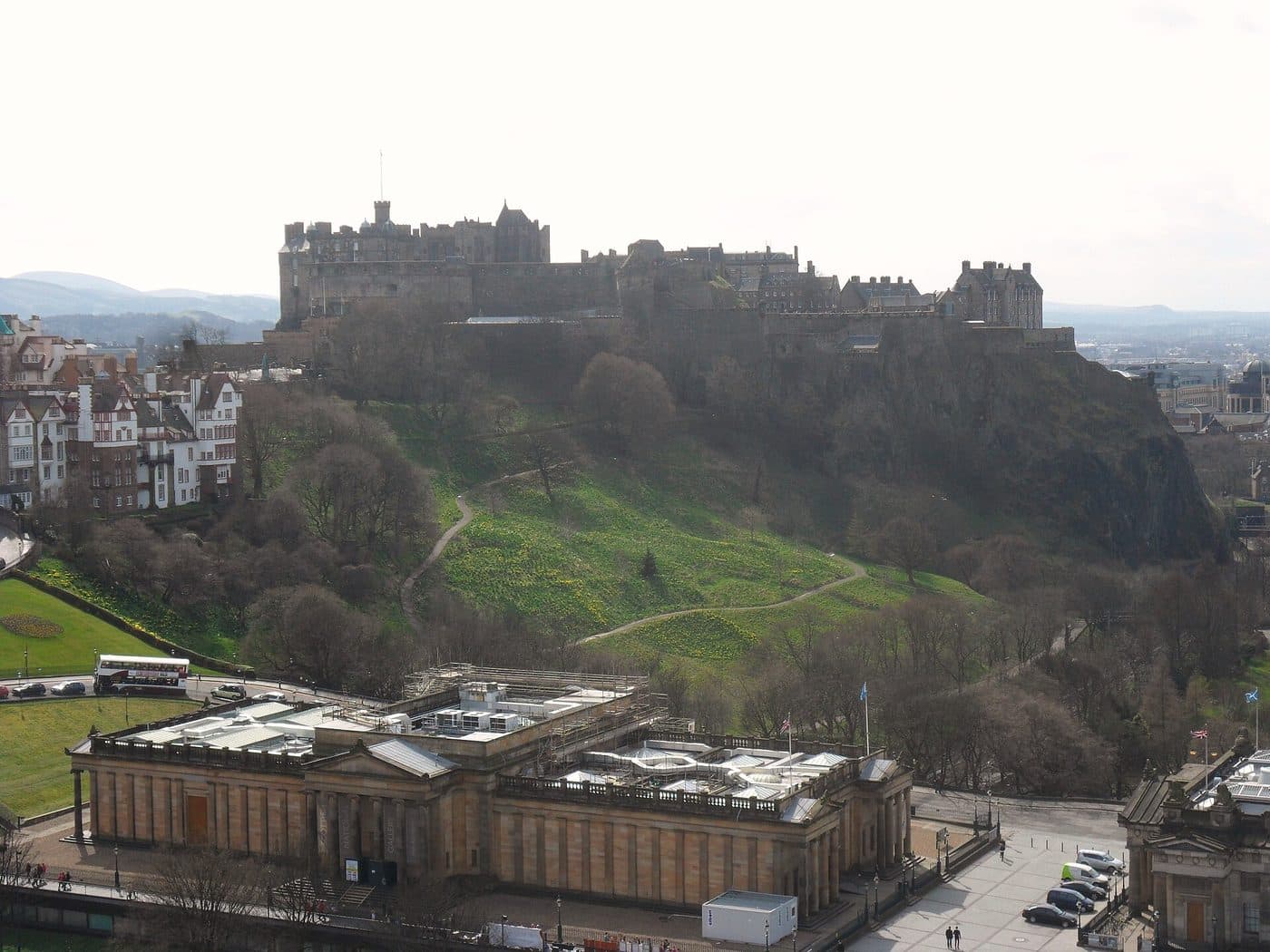
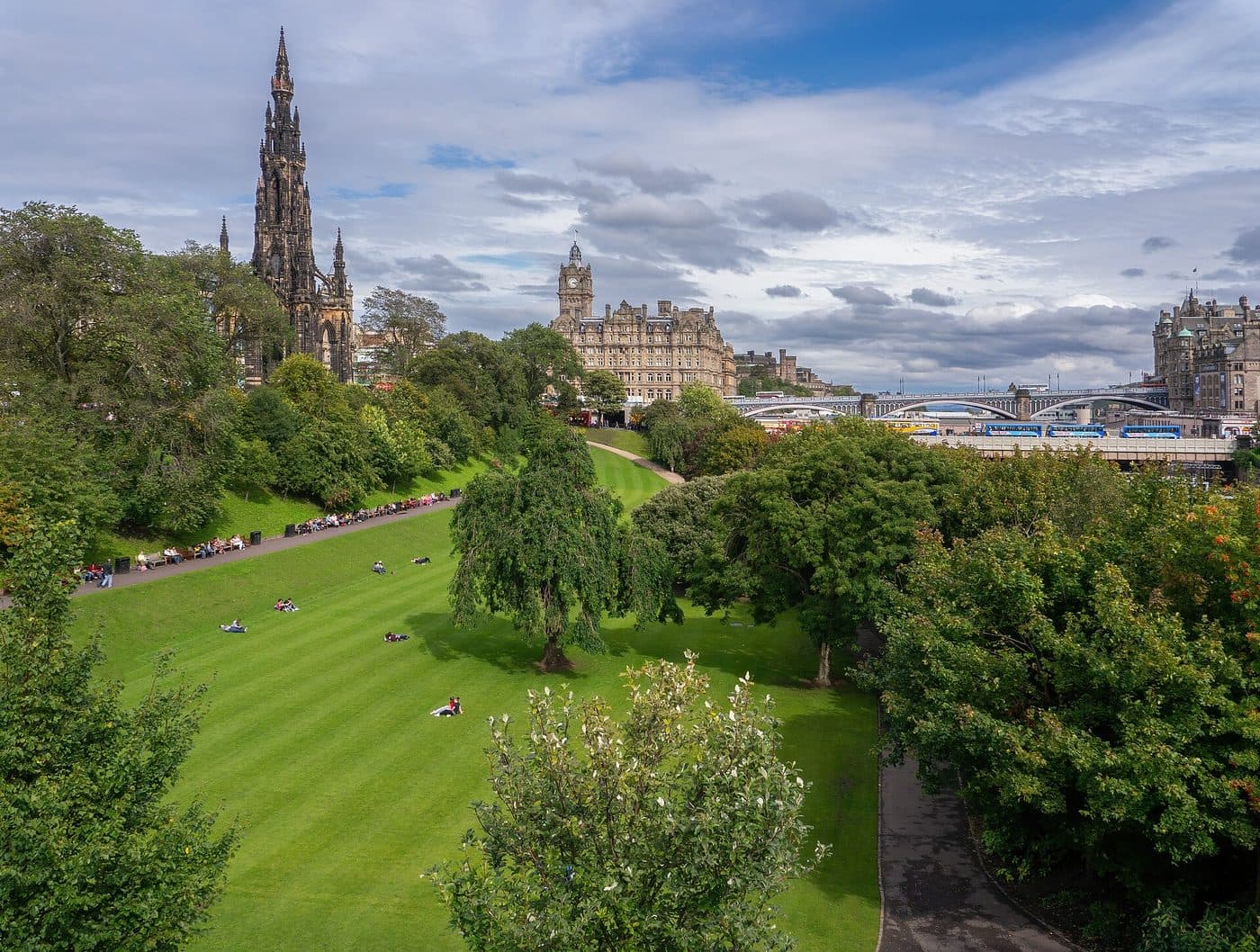
You get height in the exact place you want it. The monument stands in East Princes Street Gardens, in the trough between the New Town and the castle rock, so the platform puts you eye-level with the Old Town skyline instead of craning at it. For something in the region of eight pounds that is the best value view in the city centre, and it is not close.
But it is only worth planning around if you can use it. Four and a quarter hours of opening, no advance booking, and a narrow spiral staircase that rules a lot of people out, which the next section covers in detail. So here is the comparison that actually matters, which is not between viewpoints but between viewpoints you can guarantee:
| Viewpoint | Cost | The catch |
|---|---|---|
| Scott Monument | Around £8 | 4h 15m a day, kiosk only, narrow spiral |
| National Museum roof terrace | Free | Level 7, and the museum does not list it on its own visit page |
| Calton Hill | Free | Open hillside, no ticket, but it is a walk uphill |
| Edinburgh Castle | £23.50 | You are paying for the castle; the view comes with it |
If the monument is shut when you get there, which on a four-hour day is a real possibility, the free options above cost you nothing to fall back on. The paid alternative, and the only thing on this page we earn anything from, is the castle, where a guided ticket at least buys you a guaranteed entry time and someone explaining what you are looking at.

Edinburgh Castle Guided Walking Tour, Entry Included
Ninety minutes with a guide and castle entry included. Rated 4.89 across 5,835 reviews, the deepest review history of any castle tour we found, and unlike the monument you can actually book it in advance.
221 steps, or 287? The council and the internet disagree
Search for how many steps the Scott Monument has and you will get 287, over and over, including from Edinburgh Bus Tours, which describes the climb as 287 steps in total
. But the two official sources both give a different number.
Edinburgh City Council, which owns and runs it, says 221. Its news release of 5 August 2026, marking the monument's 180th anniversary, offered a commemorative certificate to anyone completing the climb of 221 steps
. The official tourism listing independently says a total of 221 steps
.
We cannot reconcile those figures and we are not going to invent a reason. They may simply be counting different things, and neither source explains its method. What we will say is that 221 is the number used by the people who hold the keys, and that if you are deciding whether your knees are up to it, the difference between 221 and 287 is probably not what decides it. This is what does:
| What you are dealing with | Detail |
|---|---|
| The staircase | A single narrow spiral. The tourism listing warns specifically that the upper two flights are narrow |
| Step-free access | None. One step at the main entrance and no lift and no ramp |
| Lighting | Low in some areas |
| Toilets | None in the monument |
| Personal assistants | There is a complimentary ticket policy for personal assistants |
| Museum Room, level 1 | Audio display in French, German, Spanish and Italian, plus the 19th-century stained glass designed by David Roberts |
The honest reading of that list: the first level with the museum room is reachable by almost anyone who can manage a single step, and the top is not. If the spiral is out of the question, you can still go in, see the stained glass and turn round.
Why it is black, and why they decided to leave it
Everyone assumes the Scott Monument is filthy. It is the single most common thing said about it, and the answer is more interesting than soot.
The sandstone came from Binny Quarry, near Ecclesmachan in West Lothian, which also supplied the National Gallery. The British Geological Survey classifies it as Hopetoun Sandstone and points out something unusual about it: the stone contains hydrocarbons, scattered as minute droplets through its pore system, which BGS calls a reasonably uncommon property for a Scottish building stone. As the stone weathers, some of those hydrocarbons and some of its iron migrate to the surface and the brown intensifies.
BGS then suggests that because of that oil content, smog particles from coal burning stuck to this stone more easily and faster than to other Edinburgh sandstones of the period, blackening it. And then, to its considerable credit, BGS immediately undercuts its own explanation: this could equally be down to the monument standing between the train station (old trains released a lot of smoke) and Princes Street
. We are keeping both, and the hedge, because that is what the source says.
The lovely part is what the oil also does. One of BGS's own predecessors, Dr Tait, writing in 1932, noted that the replacement of water by small amounts of oil in the pores between grains contributed to the durability of the stone
. The same hydrocarbons that made it go black help make it last.
The decision not to clean it
- In the early 1990s a proposal was made to clean the stonework.
- A scientific and geological investigation was carried out, including cleaning trials on samples of the stone.
- The decision was taken not to clean it, because of the damage that would result.
- Instead, a restoration programme replaced old repairs and damaged areas with Binny stone, and the original West Lothian quarry was re-opened to supply it.
That is Edinburgh World Heritage's account, and it turns the monument's appearance from an embarrassment into the most deliberate thing about it. Somebody tested whether it could be cleaned, found out what cleaning would cost the stone, and chose the black.
The men who built it, and what it cost them
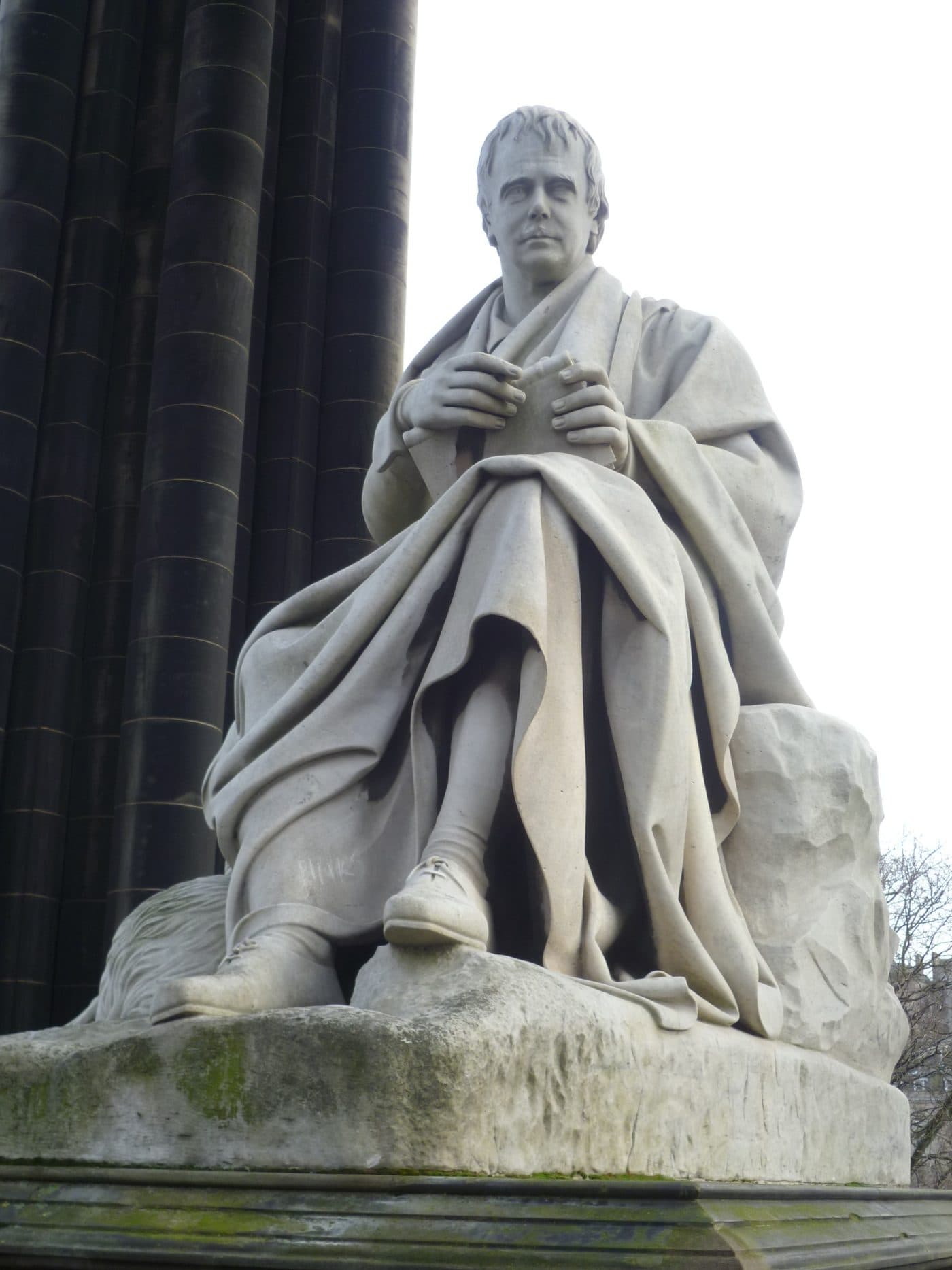
At the foot of it all sits Scott himself in white marble, with his deerhound Maida at his feet, which is the detail people photograph and the one bit of the monument that was never meant to go black.
Scott died in 1832 and the city ran a competition for a memorial. It was won by George Meikle Kemp, a joiner and self-taught architect who, according to BGS, entered anonymously. The foundation stone went down on 15 August 1840 and the monument opened in 1846. Kemp never saw it finished: he drowned in the Union Canal shortly before construction ended.
The ornament is not decoration for its own sake. BGS counts 64 statues, mostly characters from Scott's novels, and all of that carving was done by hand. BGS reports, and we are carrying its hedge, that as many as 23 of the 70 stonemasons are reported to have died of silicosis during or shortly after the monument's construction, and notes that men who started in the trade in their teens in that era rarely reached 35.
One thing sources genuinely disagree on, so we will not pick the flattering version: the official tourism site calls it the largest monument to a writer anywhere in the world, while BGS and Wikipedia both call it the second largest. It is roughly 200 feet, just under 61 metres, either way. Locals call it the Gothic Rocket, which is the council's own word for it and much the best description.
A last piece of context that most visitors miss entirely: the station you almost certainly arrived at, Waverley, is named after Scott's novels. You will often see it claimed that this makes it the only station in the world named after a book. We have not been able to verify that, so we are not repeating it as fact. What is true, and enough on its own, is that the monument is not simply a statue the city put up to a writer: the city is, in places, named after him.
If you want more Scott after the climb, the Writers' Museum is about seven minutes' walk away, off the Royal Mile, and the operator points you there for the parts of Scott's life the monument does not cover. Work the monument into the shape of your days rather than treating it as a destination, and remember the only rule that really matters here: go in the morning.
Quick answers
How many steps are there in the Scott Monument?
Edinburgh City Council, which owns and runs the monument, says 221 steps, and the official tourism site gives the same figure. Edinburgh Bus Tours says 287 steps in total, and 287 is the number repeated almost everywhere online. We cannot reconcile the two and we are not going to pretend otherwise: they may be counting different things. What we can say is that 221 is the number used by the people who own the building and by the council press release that offered a certificate for completing the climb.
How much does it cost to climb the Scott Monument?
Nobody official publishes a price, which is remarkable for a paid attraction on Princes Street. The operator’s own venue page gives no admission price and the monument does not appear in its What’s On listing. Third-party sites read on 22 September 2026 disagree: two of them give £8 adult, £6 concession and £20 for a family of four, while Edinburgh Bus Tours gives £9 adult and £7 child or concession. Take those as indications, not quotes. The kiosk at the monument is the only authority.
Can you book Scott Monument tickets online?
No. The official tourism listing states that tickets are available from the kiosk at the monument on the day and are not currently available online. There is no marketplace product for it either, which follows from the same fact. Turn up, and turn up outside the lunch closure.
What are the Scott Monument opening times?
The official listing gives 10.00 to 15.30 every day, and separately notes that the monument closes daily for lunch from 12.30pm to 1.45pm. That leaves roughly four and a quarter hours of actual opening: 10.00 to 12.30, then 13.45 to 15.30. Since you cannot book ahead and the last climb will be some time before closing, the morning slot is the safe one.
Why is the Scott Monument black?
Partly because of what the stone is made of. The British Geological Survey classifies it as Hopetoun Sandstone from Binny Quarry in West Lothian, and notes that it contains hydrocarbons as minute droplets scattered through its pore system, which is uncommon for a Scottish building stone. BGS suggests smog particles stuck to this stone faster than to others in Edinburgh because of that oil content, but then adds that the blackening could equally be down to the monument standing between Waverley station, in the age of steam, and Princes Street. Both explanations are theirs, and the hedge is theirs too.
Why has the Scott Monument never been cleaned?
Because cleaning it was investigated and rejected. Edinburgh World Heritage records that a proposal to clean the stonework was made in the early 1990s, and that after a scientific and geological investigation including cleaning trials on stone samples, the decision was taken not to clean it because of the damage that would result. Instead a restoration programme replaced old repairs and damaged sections with Binny stone, and the original West Lothian quarry was re-opened to supply it. The colour is a conservation decision, not neglect.
Is the Scott Monument accessible?
Largely not, and the official sources are honest about it. There is one step at the main entrance and no lift or ramp. Access to the top is by a narrow spiral staircase, and the tourism listing specifically flags that the upper two flights are narrow. Some areas have low lighting and there are no toilets. There is a complimentary ticket policy for personal assistants, and the first-level Museum Room has an audio display in French, German, Spanish and Italian.
Is the Scott Monument worth it?
If you can do the stairs and you are there in the morning, yes: it is the cheapest paid view in central Edinburgh by a wide margin, at roughly a third of what the castle costs, and it puts you above Princes Street rather than looking at it. If you cannot do a narrow spiral staircase, or you arrive at one o’clock, it is not a near miss, it is a no, and Calton Hill and the National Museum roof terrace both cost nothing.

About this guide
Written by Diego Fresno, Independent travel writer and researcher. Steps, opening hours, the lunch closure, the kiosk-only ticketing and every accessibility detail on this page were read on 22 September 2026 from the official Edinburgh tourism listing and from Edinburgh City Council's own news release, with each URL checked for a 200 response first. The geology, the stonemasons and the 64 statues come from the British Geological Survey; the decision not to clean the monument comes from Edinburgh World Heritage; and the operator's page was read with a headless browser because it does not render without JavaScript. Deliberately not claimed: a current admission price, because nobody official publishes one and three third parties disagree; which step count is correct, because the council says 221 and the internet says 287 and we cannot reconcile them; and exactly why the stone is black, because the British Geological Survey offers two explanations and hedges between them. We have not climbed it. Nothing on this page earns us anything from the monument, which sells its tickets at a kiosk and nowhere else; the single tour card is an affiliate link to the castle, placed after the verdict. Verified: August 2026. About the author →